Let’s have a real talk about the monster that lives under every marketer’s bed.
It’s called the Content Monster. And it’s always hungry.
It demands a new blog post every week. It wants three social media updates a day. It craves a new video for YouTube, a fresh email for your list, and a new lead magnet every quarter. You spend your life on a content creation hamster wheel, running as fast as you can just to stay in the same place.
You’re exhausted. Your creativity is drained. And you secretly wonder, “How is everyone else keeping up?”
In your search for a shortcut, a “hack,” you’ve probably stumbled across a three-letter word that sounds too good to be true: PLR.
Private Label Rights. Pre-written content—eBooks, articles, emails—that you can legally buy, put your name on, and use as your own. It sounds like the ultimate cheat code for feeding the Content Monster.
But you’ve also heard the horror stories. You’ve seen the spammy, low-quality blogs that are just copy-pasted PLR. You’ve heard that it’s bad for SEO and that it will destroy your brand’s credibility.
So what’s the truth? Is PLR a secret weapon for smart marketers or a fast track to failure?
The answer is: it’s both.
95% of people who use PLR are doing it so wrong that they’re getting worse than zero results—they’re actively hurting their business. But the other 5%? They’re using it as a strategic accelerator to dominate their niches while their competitors are still staring at a blank page.
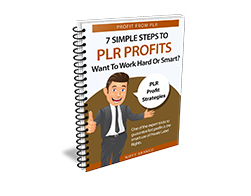
I recently broke down a short but powerful guide called “7 Simple Steps to PLR Profits,” and it reinforces the system that separates the pros from the amateurs. Today, I’m going to give you that system.
First, Let’s Be Honest: Why Most PLR Fails Miserably
Before we get to the system, you need to understand the traps. Most people fail with PLR because they make one fatal mistake: they are lazy.
They buy a PLR article pack, copy and paste Article #1 onto their blog, hit “publish,” and expect magic to happen.
This is a recipe for disaster. Why?
- It’s Duplicate Content: You’re not the only one who bought that PLR pack. If 100 other people publish the exact same article, why would Google rank yours?
- It Has No Soul: PLR is generic by design. It doesn’t have your unique voice, your personal stories, or your expert insights. It’s beige. It’s boring. It doesn’t build trust.
- It’s a Commodity: Your audience is smart. They can smell generic, soulless content from a mile away.
If you treat PLR as a finished product, you will fail. The secret is a mindset shift.
The PLR Profit Mindset: Stop Thinking “Finished Product,” Start Thinking “Raw Clay”
This is the most important lesson you will ever learn about PLR.
PLR is not a ready-to-eat meal. It is a basket of fresh, pre-chopped ingredients. You still have to be the chef. You have to combine the ingredients, add your own secret spices, and create a unique dish that nobody else can replicate.
PLR is raw clay. You have to be the sculptor who molds it into a masterpiece. It’s not a shortcut for effort; it’s a shortcut for time. It saves you from the painful process of starting with a blank page, but the work of creating something great is still up to you.
Once you embrace this mindset, you can use the following 7-step system to turn that raw clay into a profit-pulling asset.
My 7-Step System for Turning Generic PLR into a Unique, Profit-Pulling Asset
This is the exact process for doing it right.
Step 1: Start with Quality Clay (How to Buy Good PLR)
You can’t create a masterpiece from bad clay. Not all PLR is created equal. Look for PLR that is:
- Well-researched and written by a subject matter expert.
- Focused on a specific, “evergreen” niche.
- Comes with source files (like .doc files) that are easy to edit.
Avoid PLR that is poorly written, outdated, or covers a topic so broad it’s meaningless. Your starting material matters.
Step 2: Deconstruct and Rebuild (The “LEGO Block” Method)
Never, ever publish a single PLR article as-is. Instead, think like a master builder with a box of LEGOs.
Let’s say you buy a PLR pack with 10 short articles about email marketing. Don’t publish 10 short, mediocre posts.
Instead, deconstruct them. Take the two best points from Article #1, the killer intro from Article #4, and the three most important tips from Article #7. Combine them into one, new, epic blog post called “The Ultimate Beginner’s Guide to Email Marketing.”
You’ve just created a unique, high-value piece of pillar content that is 10x better than any of the original articles on their own.
Step 3: Inject Your DNA (Your Voice, Stories, and Data)
This is where you turn the generic clay into your unique masterpiece.
- Rewrite the Intro and Conclusion: This is non-negotiable. Write a brand new, compelling introduction and a powerful conclusion in your own voice.
- Add a Personal Story: Start the post with a short, relatable story about your own struggles or successes with the topic. This builds an instant connection.
- Insert Your Own Examples & Data: Replace the generic examples in the PLR with specific examples from your own business or a recent case study you found. Add a new, surprising statistic.
This step alone is enough to make the content 80% unique.
Step 4: The “Content Atomization” Strategy
Now you have one amazing pillar blog post. But you didn’t just buy one article; you bought a whole pack. It’s time to turn that pack into a full-blown marketing campaign.
The guide mentions using PLR for different formats, and this is the key. You “atomize” the raw material.
- Take one of the unused articles and turn it into a script for a YouTube video.
- Pull out 5 key tips and create a simple infographic for Pinterest.
- Combine 3-4 articles to create a short eCourse that you deliver via email.
- Use the articles as a starting point for your podcast content.
One PLR purchase can fuel your entire content calendar for a month if you’re smart about it.
Step 5: Give It a Visual Makeover
Create a brand new, compelling title for your new content piece. Then, create unique graphics. Use a tool like Canva to make a custom blog header, social media images, and a unique cover if you’re creating an eBook.
Visuals are a key part of making the content uniquely yours.
Step 6: Optimize for SEO
Now that you have your unique, high-value piece of content, treat it like any other piece of pillar content. Do your keyword research. Find the right primary and secondary keywords for your new angle and optimize the content accordingly. Add internal links to other relevant posts on your site.
Step 7: Promote It Like You Wrote It (Because You Did!)
The work isn’t done when you hit “publish.” Now you promote your new asset. Share it with your email list. Post it on all your social channels. Run ads to it.
At this point, you’ve put in the work. You’ve added your unique value. This is no longer “PLR content.” This is your content. Be proud of it and promote it with confidence.
PLR is a Tool, Not a Magic Wand
PLR is one of the most powerful accelerators a content marketer can have in their toolkit. It can save you hundreds of hours of research and writing time, cure your writer’s block, and help you consistently feed the Content Monster without burning out.
But it is not a magic wand. It is a tool. And like any powerful tool, it’s only effective in the hands of a skilled craftsperson who knows how to use it.
Be the sculptor, not the copy-paster. Be the chef, not the person just reheating a frozen dinner.
Use this system, and PLR will stop being a dirty word and start being your secret weapon.
So, what’s your take on PLR? Have you used it before, or have you been too scared to try? Let me know in the comments below.