
Let’s have a real conversation about traffic.
You’re obsessed with it. I’m obsessed with it. Every marketer on the planet is obsessed with it. We chase the latest hacks, the newest social media platforms, and the most complex SEO strategies, all in a desperate hunt for more eyeballs on our websites.
It’s an exhausting, never-ending battle.
But what if I told you that my single most powerful, most consistent, and most profitable traffic strategy is a tactic that most “gurus” today would call a dinosaur? A relic from a forgotten era of the internet.
I’m talking about Article Marketing.
I know, you just cringed a little. You’re picturing a shady, black-hat world of spinning articles and submitting them to a thousand low-quality directories. And you’re right, that version of article marketing is dead and buried, and it deserved to die.
But the soul of article marketing—the core, foundational strategy—is not only still alive, it’s more powerful and more important today than it has ever been. We just call it by a different name now: Content Marketing.
The strategy of creating a valuable, problem-solving piece of content and giving it away for free in exchange for traffic, trust, and authority is the undisputed king of all marketing. It’s the engine behind every successful online business, including my own.
The problem is, most people are terrible at it. They write articles that nobody reads, that Google ignores, and that generate zero results.
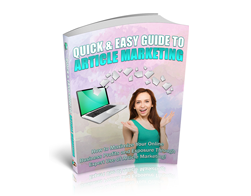
I recently broke down a simple, 21-page guide called “Quick & Easy Guide to Article Marketing,” and it was a brilliant reminder that success isn’t about complex hacks. It’s about mastering a few simple, timeless fundamentals.
Today, I’m going to give you the 2025 blueprint for this “dinosaur” tactic that will still be driving traffic for you in 2030.
The 4-Part Blueprint for an Article That Actually Gets Results
Every successful article ever written, from a viral blog post to a high-converting guest post, follows the same simple, 4-part structure. If you master this formula, you can’t fail.
Part 1: The Headline – Your 3-Second Audition
This is 80% of the battle. Your headline is not a summary of your article; it is a sales pitch for your article. Its only job is to get the click. If your headline fails, the rest of your brilliant article doesn’t matter, because no one will ever read it.
Most people write boring, uninspired headlines.
- Bad: “Tips for Social Media”
- Good: “5 Social Media Mistakes That Are Making Your Business Invisible (And How to Fix Them Today)”
The good headline identifies a pain point (being invisible), creates urgency (today), and makes a clear, specific promise. It speaks directly to the reader’s problem. Before you write a single word of your article, you should spend at least 10 minutes writing 10-15 different headlines.
Part 2: The Hook – The First 100 Words That Matter
You got the click! Now you have about 10 seconds to convince the reader to stay. Your introduction is the hook. Its job is to build rapport, confirm that they’re in the right place, and promise them a solution.
The best way to do this is with empathy. Start by describing their problem back to them in vivid detail. Show them that you understand their frustration. Then, promise them a clear path forward.
Part 3: The “Meaty Middle” – Delivering on the Promise with Value
This is the main body of your article. Your only job here is to deliver on the promise you made in your headline. But here’s the secret: how you format the information is just as important as the information itself.
Nobody wants to read a giant, intimidating wall of text. You need to make your content skimmable and easy to digest.
- Use Short Paragraphs: No more than 2-3 sentences per paragraph.
- Use Subheadings: Break up your main points with clear, descriptive subheadings (like the ones I’m using right now).
- Use Bullet Points and Numbered Lists: They draw the eye and make complex information easy to understand.
The guide talks about creating an outline first, and this is a non-negotiable step for the “meaty middle.” Before you write, create a simple outline of your main subheadings. This will keep your article focused and ensure you deliver a logical, satisfying experience for the reader.
Part 4: The Resource Box 2.0 – The Most Important Part of Your Article
This is where the money is made. The old article directories called this the “resource box.” Today, we call it the Call to Action (CTA).
Every single article you publish must have a job. Its job is to turn a passive reader into an active lead or customer. At the end of your article, you must tell the reader exactly what to do next.
- Bad CTA: “Thanks for reading!”
- Good CTA: “If you found these social media tips helpful, you’ll love my free ‘Ultimate Social Media Checklist’ that breaks down my entire daily process. Click here to download it now.”
Your CTA is the bridge that connects your free content to your business goals. Without it, your article is just a hobby.
What to Do When You Hate Writing
I get it. Not everyone is a writer. The thought of creating content fills some people with dread. The guide has a great section on this. Here are the pro-level shortcuts:
- Be a Reporter, Not a Writer: You don’t have to create everything from scratch. You can interview an expert in your field, record the conversation, get it transcribed, and then edit that transcription into an amazing article. You’re leveraging someone else’s expertise.
- Repurpose, Repurpose, Repurpose: Did you record a video or a podcast? That’s your next blog post. Get it transcribed and turn your spoken words into a high-value article.
- Outsource the Grunt Work: You can use a freelancer to turn your detailed outline into a first draft, which you can then edit and polish in your own voice. This saves you 80% of the writing time.
Conclusion: The Game Hasn’t Changed, Only the Stadium Has
The old-school tactic of submitting to article directories is dead. But the strategy of creating high-value, problem-solving articles is the foundation of all modern digital marketing.
You don’t submit to directories anymore. You publish on your own blog to build your SEO and your brand. You publish on platforms like Medium and LinkedIn to reach a new audience. You use your articles as guest posts on authoritative sites to build powerful backlinks.
The stadium has changed, but the rules of the game are exactly the same. Master this simple formula, and you will never have to worry about traffic again.
This 21-page guide is the perfect primer on these timeless fundamentals. It’s a quick, easy read that will get you on the right track.
And to help you master the game, I’m giving you the entire guide. You can download the “Quick & Easy Guide to Article Marketing” for free.
What’s your biggest struggle when it comes to creating content? Let me know in the comments below.