Let’s talk about the most powerful, most misunderstood, and most intimidating force in the entire digital world.
The Google Algorithm.
It’s a mythical beast. A black box that holds the keys to a kingdom of free, unlimited, “ready-to-buy” traffic. We obsess over it. We try to appease it. We live in constant fear of its wrath.
The “gurus” have turned it into a dark art, a secret language of “canonical tags,” “schema markup,” and a hundred other technical terms designed to make you feel stupid and convince you that you need to pay them thousands of dollars to navigate its mysteries.
It’s a scam.
Here’s the truth they don’t want you to know: The Google algorithm is not your enemy. It is not a riddle you need to solve. It is a machine with one, simple, unwavering goal. And if you understand that one goal, you can stop chasing the algorithm and start making it work for you, forever.
What is that one goal?
To provide the user with the single best, most relevant, most satisfying answer to their question.
That’s it. That is the entire game.
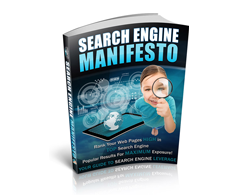
I recently broke down a 23-page guide called “Search Engine Manifesto,” and while some of the specific tactics are a bit dated, its core philosophy is the timeless, foundational truth of SEO. It’s a manifesto for how to win at the game of search, not by tricking the machine, but by aligning with its one, core purpose.
Today, I’m going to give you the modern-day manifesto. The simple, 3-part system that is the foundation of all lasting SEO success.
The Search Engine Manifesto: 3 Unbreakable Laws
Forget the 200+ ranking factors. Forget the noise. If you commit to these three laws, you will win.
Law #1: You Must Become a Mind Reader for Your Customer (The Art of the Keyword)
This is the foundation of everything. Before you write a single word, before you build a single link, you must get inside the head of your ideal customer.
You need to stop thinking in terms of “keywords” and start thinking in terms of “user intent.” What is the real, human problem behind the words they are typing into the search bar?
The guide talks about “selecting search engine keywords,” but the real art is in understanding the different types of intent.
- Informational Intent: The searcher wants to learn something. (“how to change a tire”)
- Navigational Intent: The searcher wants to go to a specific website. (“youtube”)
- Commercial Intent: The searcher is researching a future purchase. (“best running shoes for flat feet”)
- Transactional Intent: The searcher is ready to buy, right now. (“buy nike air zoom pegasus 38”)
The secret to winning at SEO is to create specific pieces of content that perfectly match each of these intents. Your blog posts might target informational keywords. Your product category pages target commercial keywords. Your product pages target transactional keywords.
When you align your content with the user’s intent, you are directly helping Google achieve its #1 goal.
Law #2: You Must Create the “Last Click” They’ll Ever Need (The Science of Great Content)
Once you know the user’s intent, your mission is simple, but not easy. You must create a piece of content that is so good, so comprehensive, and so satisfying that the user never needs to click the “back” button to look for a better answer.
This is what I call creating the “last click.”
Google’s algorithm is incredibly sophisticated at measuring user satisfaction. It looks at signals like:
- Dwell Time: How long does the user stay on your page? A long dwell time signals that they found your content valuable.
- Click-Through Rate (CTR): Are people clicking on your result in the search listings? A high CTR signals that your headline is compelling and relevant.
- Pogo-Sticking: Does the user click on your result, quickly hit the “back” button, and then click on a different result? This is a massive red flag that your content was a disappointment.
You don’t “game” these signals. You earn them by creating the absolute best piece of content on the planet for that specific keyword. It needs to be more in-depth, easier to read, more up-to-date, and more helpful than every other result on page one.
Law #3: You Must Earn the Trust of the Internet (The Power of Link Popularity)
You’ve created the best piece of content in the world. How does Google’s machine know it can trust you?
It knows because other trusted, authoritative websites are “vouching” for you. In the language of search engines, a “vouch” is a link.
The guide calls this “building your link popularity,” and it is the single most powerful “off-page” ranking factor. Every link from a relevant, high-quality website to your page is a vote of confidence. It’s a signal to Google that says, “Hey, this content over here is legit. You should show it to more people.”
But here’s the secret: You don’t “build” links. You earn them.
You earn them by creating the kind of “last click” content we talked about in Law #2. You create content that is so valuable, so interesting, or so data-rich that other bloggers, journalists, and industry experts want to link to it because it makes them look smarter for sharing it with their audience.
This is the cycle of success:
- You understand user intent.
- You create the best answer.
- That amazing answer naturally attracts links and authority.
- That authority helps all of your other pages rank higher.
That is the entire game. Everything else is a footnote.
Conclusion: Stop Chasing the Algorithm. Start Serving the User.
The beauty of this manifesto is that it’s future-proof. The algorithm will change a thousand times. New ranking factors will come and go. But its core mission—to serve the user—will never, ever change.
If you make that your core mission too, you will never have to worry about a Google update again. You will be building a long-term, sustainable traffic asset that is immune to the whims of the algorithm because you are aligned with its deepest purpose.
This 23-page guide, “Search Engine Manifesto,” is the perfect starting point for understanding this core philosophy. It cuts through the technical jargon and focuses on the strategic foundation.
And to help you start building your business on that solid foundation, I’m giving you the entire manifesto. You can download the “Search Engine Manifesto” for free.
Stop trying to trick the machine. Start helping the human on the other side of the screen. The traffic will follow.