Let’s talk about the scariest button in all of online marketing.
It’s not the “delete account” button. It’s not the “publish” button on a controversial post.
It’s the button that says “Launch Campaign.”
The moment you click it, you’re officially in the world of Pay-Per-Click (PPC) advertising. You are paying real money for every single person who clicks on your ad. It feels like you’ve just turned on a faucet connected directly to your bank account, and you’re terrified that it’s all going to pour down the drain with nothing to show for it.
For 90% of business owners, that’s exactly what happens. They throw $500 at Google Ads, get a bunch of confusing data and zero sales, and walk away convinced that “PPC doesn’t work.”
They’re not wrong. For them, it didn’t work. But it wasn’t the tool’s fault. It’s like blaming a hammer for not being able to build a house. The problem isn’t the tool; it’s the lack of a blueprint.
PPC is not a slot machine you gamble on. It is a high-performance engine. If you don’t know how to build and tune it, it will explode on the starting line. But if you do… it can be a money-printing machine that delivers a predictable, scalable flood of your ideal, ready-to-buy customers to your website, on demand.
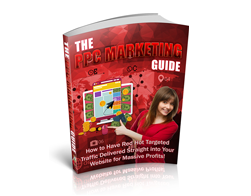
I recently broke down a lean, 18-page guide called “The PPC Marketing Guide,” and it’s a brilliant blueprint for building that engine. It cuts through the intimidating jargon and focuses on the core mechanics that actually drive profits.
Today, I’m going to give you the system that turns PPC from a money furnace into a money printer.
The Foundational Mindset Shift: You’re Not Buying Clicks, You’re Buying Data
This is the most important secret you will ever learn about PPC. If you get this, you will win.
The goal of your first PPC campaign is not to make a profit. Read that again.
The goal of your first campaign is to buy data.
Every click you pay for is a piece of market research. You are paying to learn, with 100% certainty, what your customers are actually searching for, which headlines grab their attention, and which offers make them pull out their credit cards.
SEO can take months or even years to give you that kind of feedback. PPC can give it to you by tomorrow morning. It’s the ultimate shortcut to understanding your market. Once you see it as a strategic investment in data, not a cost, the entire game changes.
Winning Before You Spend a Dime: The Art of the “Buyer Intent” Keyword
Most people start their PPC journey by guessing. They think, “I sell plumbing services, so I’ll bid on the keyword ‘plumbing’.”
This is like trying to catch a fish with a giant net in the middle of the ocean. You might catch something, but you’ll probably just waste a lot of energy.
A pro doesn’t guess. They target keywords with surgical precision, focusing only on keywords that signal commercial or “buyer” intent.
Think about the difference in mindset between these two searchers:
- Searcher A (Informational Intent): “how to fix a leaky faucet”
- Searcher B (Buyer Intent): “emergency plumber near me”
Searcher A is in “learning mode.” Searcher B is in “buying mode.” Their wallet is already out. They have a painful, urgent problem, and they are looking for someone to pay to solve it, right now.
The secret to a profitable PPC campaign is to ignore Searcher A (for now) and focus all of your budget on finding and targeting Searcher B. Your entire business can be built on a handful of these high-intent keywords.
The 3 Levers of a Profit-Pulling PPC Machine
Once you have your buyer-intent keywords, building the campaign comes down to three simple, interconnected parts.
Lever 1: The Ad – Your Digital Billboard
Your ad has one job: to get the right person to click. The key to a great ad is relevance. The headline of your ad should match the keyword the person just searched for as closely as possible.
If someone searches for “emergency plumber near me,” your ad headline should be something like “24/7 Emergency Plumber – We Can Be There in 60 Minutes.”
This tells the searcher, “Yes, you are in the right place. I have the exact solution to your immediate problem.”
Lever 2: The Landing Page – Where the Sale is Made
This is where 99% of campaigns fail. They write a great ad and then send the traffic to their generic, unfocused homepage. It’s a conversion killer.
You must send your PPC traffic to a dedicated landing page that has one job and one job only: to convert that visitor into a lead or a sale.
Most importantly, the landing page must have message match with your ad. If your ad promised a 60-minute emergency plumber, the first thing on your landing page better be a big, bold headline that says, “Need an Emergency Plumber Fast? We’ll Be There in Under 60 Minutes.”
This continuity builds trust and tells the visitor they’ve made a good click.
Lever 3: The Bid & The Tracking – Flying with Instruments
The guide talks about PPC bid management, and this is where you stop gambling and start flying with instruments.
You need to have conversion tracking set up. This is a simple piece of code that tells you when a click from your ad results in a real business outcome (like a phone call, a form submission, or a sale).
Once you have this, you can stop guessing how much to bid. You can look at the data and say, “I know that for every 10 clicks I get from the keyword ’emergency plumber near me,’ I get one new customer worth $300. Therefore, I can afford to pay up to $30 per click and still be wildly profitable.”
This is how you turn PPC from a game of chance into a predictable, mathematical system.
The Ultimate Showdown: To SEO or To PPC?
This is the question every marketer asks. The guide touches on it, and the answer is simple.
It’s not “or.” It’s “and.”
- PPC is your spear. It’s fast, precise, and perfect for getting immediate sales and data.
- SEO is your moat. It’s slow to build, but once it’s established, it’s a massive, long-term, free traffic asset that protects your business.
The ultimate strategy? Use your PPC campaigns to buy the data. Find the exact, high-converting “buyer intent” keywords that are printing money for you. Then, take those proven keywords and make them the focus of your long-term SEO strategy. You’re using the speed of PPC to fuel the long-term power of SEO.
This 18-page guide is the perfect, no-fluff introduction to this powerful system. It will give you the blueprint you need to stop being intimidated and start building your own traffic engine.
And to help you turn on that engine, I’m giving you the entire guide. You can download “The PPC Marketing Guide” for free.
Stop waiting for traffic. It’s time to go out and get it.